The purpose of building Fort Osage, and therefore establishing a military presence, was the projection of the government’s Indian policy, using trade as the great engine for peace. Maintaining peace in the territory had special overtones at this particular time. The United States was the only nation that recognized the Louisiana Purchase as valid. Immediately after signing the treaty and receiving payment, France sent troops to Santo Domingo to await orders to invade the territory and take it back by force. Spain refused to recognize the United States’ claim and contended that due to a previous treaty between France and Spain the treaty was illegal. England ignored any treaty with France and refused to abandon their long-standing goal of continental domination.
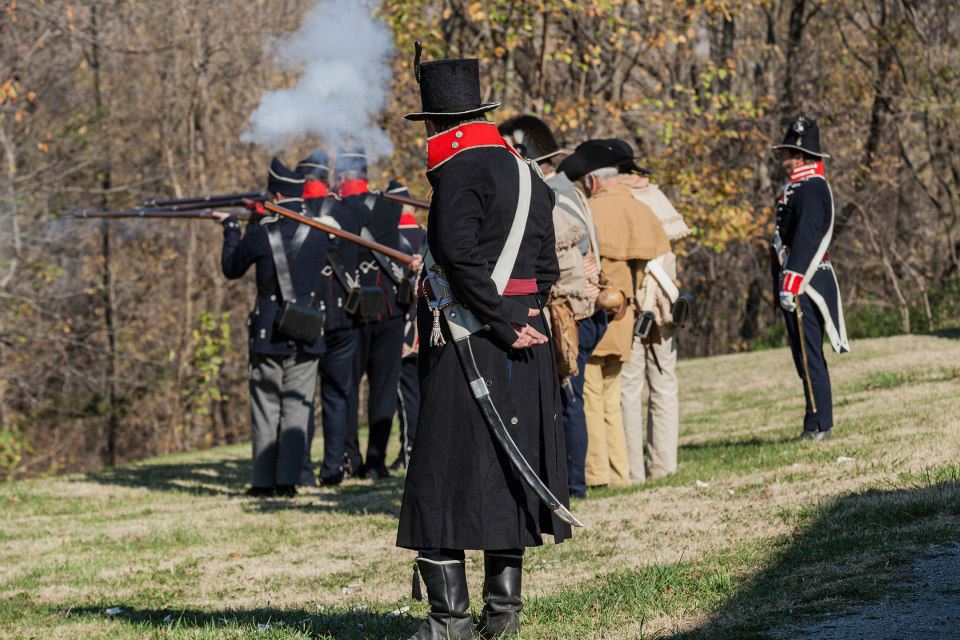
There were originally around 77 enlisted men including 4 officers in the First Infantry Company under the command of Captain Eli B. Clemson. His second in command, Lt. Lorimier, resigned on December 31, 1809, and was replaced by Lt. John Brownson in 1810. The First Infantry remained at the Fort until May of 1813. By 1812 the number had dropped to 50 enlisted and four officers. The regulars enlisted for a minimum of five years and received $5 per month. Daily rations for each private included 1.25 lbs. of beef or .75 lbs. of pork, 18 ounces of bread or flour, and one gill of rum whiskey, or brandy. The army also regularly issued 100 candles, two pounds of soap, two quarts of vinegar, and one quart of salt for every 100 rations. The soldiers had the option of engaging in “extra duty” to augment their rations and income. By working for Sibley, or anyone else at the Fort, the soldiers could earn 10 cents per day for common labor and 16 cents for skilled trades alone. With these funds, they could also earn an extra gill of rum. Furnishings for the enlisted personnel were simple. Each man had a knapsack, in which to store his personal items. The regulation allowed the men in each barracks to build or trade for a wooden table, benches, or shelves. Although the War Department specified that all furnishing were to be painted white, the supply of paint sent to the outpost varied in color that included red, blue, and black.
The Officer’s barracks, by contrast, was furnished in a manner that was in keeping with their social-economic status. Congress declared that the officers should be allowed to live as gentlemen as much as possible. At Fort Osage, the officer’s quarters got the best in the factory system and consisted of four rooms on two floors with oak floorboards painted red and plastered walls. Documents indicate that Captain Clemson’s wife and mother lived at the fort. Sentries were on duty 24 hours a day in the main blockhouse. To supplement their diets, the soldiers always had a garden. Punishment, most of it in the form of flogging, was abolished spring of 1812. At its flag mast, Fort Osage flew the “Star-Spangled Banner” flag-the only official flag with fifteen stars and fifteen stripes. The soldiers raised the flag every morning at daybreak and lowered it just before sundown.